

Back to SDK
PDF
PDF & PDF/A
in the PDF Xpansion SDK
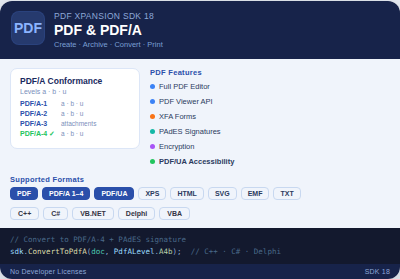
PDFPDF/APDF/UAXPS/OXPSTXTRaster ImagesSVGEMFHTMLThe PDF developer tool provides powerful APIs that enable you to develop PDF/XPS-capable applications and/or software solutions. Among other things, it offers extensive capabilities for creating and editing PDF, PDF/A and XPS documents, for displaying them in a multifunctional viewer and printing them on paper, for converting between these formats, and for exporting and/or importing from/to other file formats. With this API you can easily integrate PDF functionality into both desktop applications and server services for Windows as well as extensions for MS Office.
With our powerful PDF library, end users get a fully-featured PDF editor that makes editing page content effortless. In addition, a comprehensive, ready-made PDF viewer is available, ensuring convenient viewing and navigation of PDF documents. It enables the display and processing of dynamic forms in XFA format for C++ and .NET applications. Nearly every language worldwide is also supported. Using the API, form data can be easily read and filled in.
PDF/A
With the developer library, you can integrate functions for creating PDF/A-1, PDF/A-2, PDF/A-3 and PDF/A-4 files into your applications. All currently existing conformance levels (a, b, u) of the PDF/A format are supported. In files that comply with the PDF/A-3 standard, not only PDF/A files but any files may be embedded. This means that a PDF/A-3 file can contain, for example, the original source file as part of an archiving solution, or an XML file for invoice processing systems.
PDF/UA
Accessibility is becoming increasingly important – both legally and socially. The SDK therefore supports the merging and saving of accessible PDF/UA documents that are usable by all users.
PDF Viewer
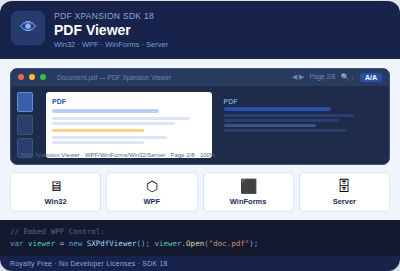
The SDK offers a PDF viewer for several development platforms. With these platform-specific implementation options, you can quickly and easily add a viewer for PDF, XPS, text and image files to your application. You can also use the implementation types to display PDF documents in your own structure and layout.
The viewer offers a wide range of common functions, for example various layouts, zoom options and scroll bars. Using the SDK's powerful and efficient event mechanism, you can also equip the viewer in your application with capabilities that go beyond simple standard functions. You can implement special interactive end-user tools (see the ToolMode property of the viewer in the PDF Xpansion SDK Reference) to enable visual work with PDFs and other documents.
Depending on the development platform, the viewer is a window or a control in which PDFs, XPS or other documents and processes are displayed to end users. Users can then perform actions via touchscreen, mouse and keyboard.
PDF Serial Documents
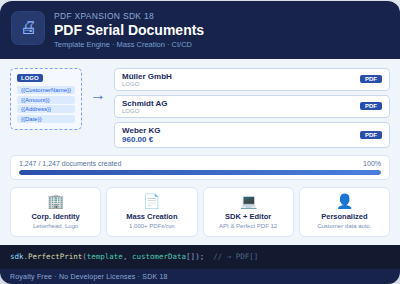
The mass creation of PDF documents based on templates makes it possible to efficiently generate a large number of personalised documents. A uniform template is used containing elements such as letterhead, header and footer to ensure a consistent corporate identity. These templates can then be populated with individual customer data to produce tailored documents such as invoices or quotes.
Templates can be created either programmatically via the SDK API or designed with the interactive editor in Perfect PDF 12. The advantage lies in the time savings and the avoidance of manual errors, as all documents are generated automatically and consistently.
Core Functionality
- Open file/stream
- Save file/stream
- Opening and saving encrypted documents including document encryption
- Save changes as a document version in a PDF file
- Load linearised part / save linearised file/stream
- Split/merge documents
- Assemble pages
- Combine content from pages
- Copy pages within a document
- Page management (add, move, remove, resize, etc.)
- Search text in documents (text export)
- Print document
- Render and/or display pages
- Digital signatures
- Validate and sign, with timestamps
- Certification signatures, document timestamps
- PAdES signatures – validate all conformance levels, sign with conformance levels B and T
- PAdES signatures – sign with conformance levels LT and LTA
- Form fields – fill in and read out, create and edit properties
- FDF, XFDF (import / export / submit), HTML (submit)
- Links, bookmarks (table of contents, outline), named destinations
- Annotations – processing with the SDK API
- Text markup
- Notes, stamps, watermarks
- Text box & callout
- Pen, eraser
- Redaction
- Shapes (line, rectangle, circle, etc.)
- Media and 3D annotations
- File attachments as annotations
- Replies & status indicators for annotations
- Layers
- Embedded files
- Data relationships for embedded files
- XMP metadata processing
- Collections of fonts / images
- Logical document structure and marked content (Tagged PDF)
- PDF creation / processing
- Determine PDF content (Rich Content API, non-interactive)
- Create and edit new PDF content (Rich Content API, non-interactive)
- Edit PDF content = determine + recreate
- Convert to PDF/A-1
- Convert to PDF/A-2
- Convert to PDF/A-3
- Convert to PDF/A-4
- Save as PDF/UA
- Import from XPS (open XPS and save as PDF required)
- Import GDI metafiles (EMF) as PDF page
- Import GDI+ metafiles (EMF+) as PDF page
- Import SVG fully as PDF page
- Execute JavaScripts
- Optimisation
- Flatten fields, annotations and layers
- Optimise page content
- Optimise document object model
- Convert text elements to vector graphics
- PDF Viewer
- Fill in forms
- Pop-ups, thumbnail view, viewer snapshots (viewer state)
- Media player API
- WPF control
- Magnifier & snapshot tools
- Tracker tool (incl. adding notes, stamps, watermarks)
- Rectangle tool (incl. adding fields, links, etc.)
- Text (selection, markup)
- Stylus
- PDF annotation management (incl. move, resize, remove)
- PDF text box & callout
- PDF pen, eraser
- PDF shapes (line, rectangle, circle, etc.)
- Page content editing tool (Rich Content API required)
- Text box editor
- Dynamic notes
- Text markup
- Annotations & pen
soft Xpansion Support
Perfect PDF 12 & PDF Xpansion SDK
🗑
✕